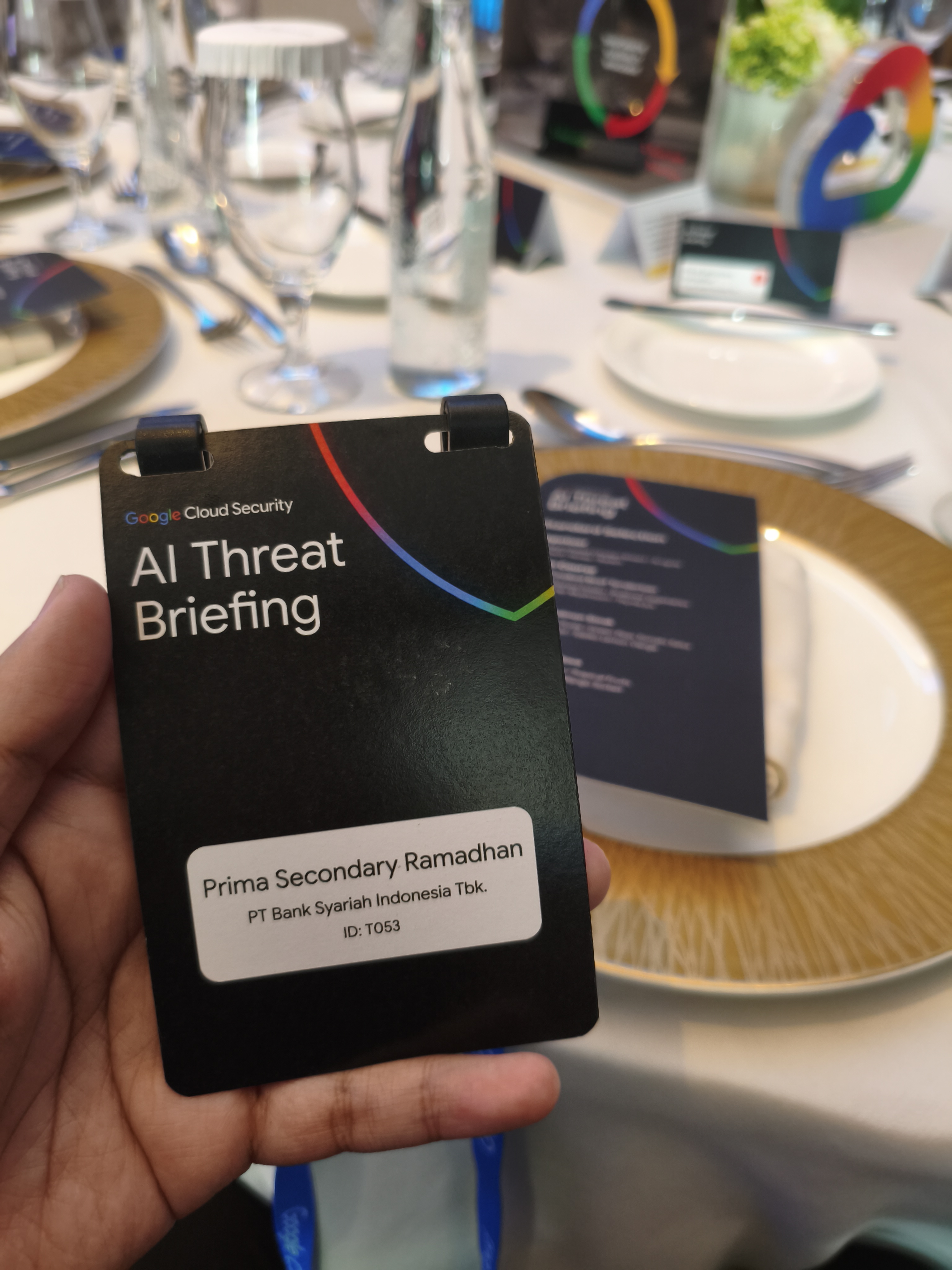
I was invited to an event hosted by Google Cloud Security called AI Threat Briefing, held on September 24, 2026, at The Westin Jakarta.
The event was mainly about how AI is changing cybersecurity. Not only from the defender's side, but also from the attacker's side. AI can help security teams work faster, but attackers can also use it to find vulnerabilities and develop new ways to attack systems.

AI Threat Landscape #
The first session was about the AI Threat Landscape.
They talked about how AI is bringing new threat actors, techniques, and attack surfaces. One thing that stood out to me was how quickly vulnerabilities can now be discovered, especially with AI being used to find and exploit zero-day vulnerabilities.
There is also a pretty big gap between finding a vulnerability and actually fixing it. A vulnerability might be discovered very quickly, but patching it across an entire environment can take much longer.
This is why detection and response are becoming even more important. It's not enough to know that a vulnerability or attack exists. Security teams also need to be able to understand what is happening and respond as quickly as possible.
Google's AI Threat Defense Framework #

The second session introduced Google's AI Threat Defense Framework. It is divided into four stages:
- Prepare
- Scan and Prioritize
- Remediate
- Monitor
The Prepare phase is about making sure the foundation is ready and setting up the processes needed to prioritize and respond to vulnerabilities quickly.
The Scan and Prioritize phase focuses on deeper analysis and using AI to validate the security posture. Basically, the goal is to figure out which vulnerabilities are actually important and should be handled first.
Then comes Remediate, which focuses on creating a workflow that can verify and patch vulnerabilities quickly.
The last one is Monitor, which focuses on continuous detection and having response procedures that are ready to be used when something happens.
What I like about this framework is that it covers more than just finding vulnerabilities. It looks at the whole process, from finding the problem to fixing it and continuing to monitor the environment afterward.
The Demos #

The third part of the event was the demo session. They showed several of their security products and services, including Wiz, CodeMender, Mandiant Consulting, Google Security Operations, and Google Threat Intelligence.
The one that interested me the most was Wiz.
From what I saw, some parts of Wiz reminded me of a SIEM because it can bring together a lot of alerts and incidents from different data sources. But the part I found more interesting was what you can see when you open an alert.
You can follow the causality chain and see how the attack happened, including what happened before and after the alert was generated.
For me, this is quite useful. An alert by itself doesn't always tell you much. Being able to see the relationship between different activities makes it much easier to understand what is actually happening during an attack.
And Yes, the Food #

I also can't forget about the food.
The meals provided by the hotel were really good. It was mostly Western-style food, with an appetizer, main course, and dessert.
The food was good, the drinks were good, and the snacks were good too. So, no complaints there.
Overall, I really enjoyed the event. The speakers were knowledgeable and the topics were relevant, especially with how quickly AI is becoming part of the cybersecurity landscape.
For me, it was a good chance to refresh some of my existing knowledge and learn about what Google is doing in the AI and cybersecurity space.
AI is developing very quickly, and I think security professionals need to keep up with it. Not just to understand how we can use AI, but also to understand how attackers might use it against us.